
By Jude Huck-Reymond

The discovery of an efficient means of solar energy production and the successful transition to a sustainable energy sector is fundamental to our success and survival as a species. In particular, limiting future emissions and fossil fuel dependence will create more reliable energy sources and a healthier living environment for all life on Earth. Moreover, the development of this technology has allowed us to make predictions about how it may affect the cultural and social significance of future commodities. Furthermore, the cost per watt of solar energy has decreased exponentially and its efficiency has increased linearly over time [4]. Likewise, energy storage systems are becoming cheaper and more efficient at the same time.
For the span of humanity, we have not fully understood the impacts of our energy production sources, particularly the burning of fossil fuels. There exists a dated, centralized energy production industry that if displaced, could create trillions of dollars of economic opportunity in the future.
With the abundance of solar power and reductions in costs, how could we ignore the impending transition to sustainable energy sources? An electrified grid could have massive implications on the costs of transportation, labor, and most other systems that can be automized or mechanized.
A transition to sustainable energy will create a future of energy abundance, and a succeeding abundance of most other necessary resources. Therefore, this transition is paramount to the outcome of our society and should be supported with full enthusiasm.
Why a Transition is Necessary

To introduce the necessities and impacts of a nationwide transition to solar energy, we must first introduce America’s historical energy consumption habits and their effects on the individual, communal, and social aspects of the nation as a whole. Since the conception of the United States, the country’s society has become progressively more dependent on fossil fuel sources including coal, natural gas, and petroleum. The peak consumption volume of these three fuel sources was around 85 quadrillion, billion BTU (British Thermal Units) in 2008 and has since started a slow decline overall [1]. As shown on the left in Figure 1, coal appears to be following the steepest decline with natural gas compensating for most of the missing energy.

The necessity of these fuel sources lies throughout American culture. First, on the right in Figure 1, Transportation lies at the top of the mountain of consumption [1]. Over the past couple of centuries, America has invested hundreds of billions of dollars in creating a highway system for personal vehicles to use. Until recently, these vehicles were solely running on petroleum.
In speculation, individuals with assets in fossil fuels heavily supported the investment in the necessary infrastructure to use their products. This dependence on roads and personal vehicles created a country-wide dependence on petroleum fuel.
Transportation accounted for 68% of total petroleum use in 2020 [1]. In time, this allowed large, centralized fossil fuel corporations to watch profits and margins grow exponentially, meanwhile, selling the popular idea of freedom on the open roads to their consumers.
The other large contributor to fossil fuel consumption as shown in Figure 1 is electricity production [1]. Following a similar, centralized business strategy to petroleum, utility companies have decided historically that using coal and natural gas plants is the most efficient and economic means of energy production. Recently, the evolution in natural gas technology has made it a more cost-effective energy source, explaining the trends shown on the left in Figure 1 [1].
The entire country’s energy grid consists of eastern and western sub-grids, split along the midwest; and Texas has its own grid. In recent years, the limits of this 70-year-old grid have been tested by turbulent weather. Rolling blackouts and insufficient energy distribution happen nationwide and in Texas in particular [2]. Moreover, the grid’s overall lifespan was set at approximately 50 years by the American Society of Civil Engineers [2].
Not only has the existing grid become less dependable over time, but our current energy sources also produce emissions harmful to humans, nature, and a dependable climate. In 2019, the U.S. produced 6.5 billion metric tons of emissions, with ~80% Carbon Dioxide, ~10% Methane, and ~10% Nitrous Oxide and other Fluorinated Gases as shown in Figure 2 [3]. These emissions trap heat in the atmosphere and the excess energy causes volatile weather patterns, eventually destroying the Earth’s environment as we have known it historically.
Without a transition, our nation will continue dumping billions of metric tons of emissions into the atmosphere every year. In speculation, the climate in a future with these emissions will cause exponentially more turbulent weather, volatile temperature changes, and the dissipation of seasons on Earth as we’ve known them historically.

Greenhouse gas emissions have more specific effects that give an idea of how influential our emissions can be. First, ocean acidification can disrupt pH balances and decimate aquatic ecosystems. Over the last 150 years, ocean acidity has increased by around 30% [3].
Next, as extreme weather becomes more common, storms, wildfires, hurricanes, droughts, and floods will be more drastic and costly. It is estimated that extreme weather costs around $600 billion between 2016 and 2020 [3].
Sea level rise could cost the U.S. another $400 billion over the next few decades as the sea level has risen 9 inches since the start of industrialization in America. Moreover, 40% of the population lives along the coastline, making the effects all the more displacing [3].
Finally, air pollution caused by direct emissions into the atmosphere, and water pollution as a product of leaking or spilling oil have had and will have an effect on human and environmental health as long as we burn fossil fuels for energy. Overall, these energy sources are harmful, dirty, and allow corporations to centralize business strategies, preventing the public from creating energy independence for themselves.
Solar Energy Physics
Solar panel technology has been following a linear increase in efficiency over the last 30 years, meanwhile, following an exponentially decreasing capital cost per watt as shown in Figure 3 [4]. These trends are paramount in understanding the effectiveness and sustainability of solar energy production. In 1954, Bell Laboratories introduced the first functional photovoltaic solar cells in the U.S. with minimal efficiency [5]. Nowadays, you can expect between 15-20% efficiency for any solar power products you buy.

Figure 3.
Photovoltaic technology capitalizes on the photoelectric effect first discovered by Becquerel in 1839 and later postulated by Einstein in the early 1900s. Essentially, these physicists discovered that certain materials could produce a small current when exposed to a light source.
The physics depends on a variable in semiconductor materials called the bandgap, which is essentially the energy gap necessary to leap in order to create a current through a semiconductor material. Since then, technology has been developed to try to find the optimal material and maximize the current moving through the material.
Nowadays, semiconductors are highly developed and can be found in most electronic appliances. Despite following fruitful efficiency and cost curves, the technology originally evolved through developments in spaceflight, not for widespread consumer use [5].
Since its efficiency has proven to be cost-effective, it has become a more reasonable energy source in the last decades. In speculation of the trends shown in Figure 3, efficiency will continue to increase over time, and cost per watt will continue decreasing over time, making it continuously more cost-effective compared to traditional energy sectors.
A solar panel is made up of an array of solar cells. As mentioned above, these cells use semiconductor materials, usually silicon, that are flattened into a “wafer” to produce a small electric field with positive and negative poles. The electrons in this wafer are held very loosely by the material (having a small bandgap), so when light strikes the surface, it breaks the binding energy between electrons and nuclei and the solar cell can collect these electrons in the form of an electric current. Collections of solar cells are most commonly arranged in modules and modules are arranged in an array to produce energy for the consumer [5].
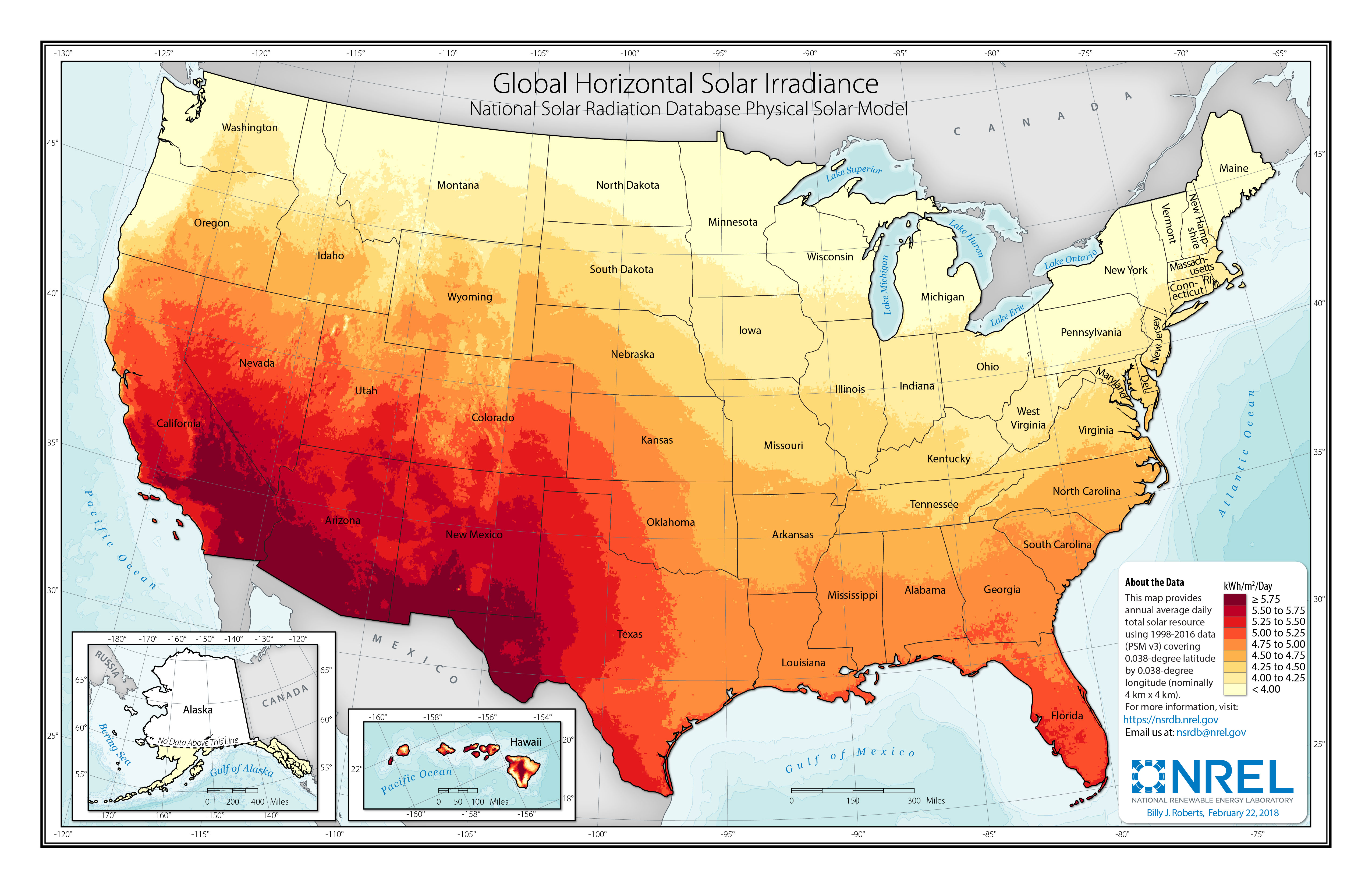
Energy production is directly proportional to the sunlight received and the area of the array. The area is a controllable factor, however, the sunlight received is not. Geographic location has a drastic impact on the array’s efficiency. This includes both the strength of the sunlight hitting the panels, irradiance, and the expected weather patterns in the area.

Figure 4.
The sun’s irradiance in the U.S. is shown in Figure 4. The darker the color, the higher the irradiance level in the area. This implies that a solar array in western Texas would be more efficient than an array in Minnesota for example, based on irradiance alone. Moreover, the weather, particularly humidity, can affect an array’s efficiency. When clouds produce shade over the array, it reduces efficiency.
Here lies the risk of ineffective cost in the technology. If an array is implemented in an area where solar energy is not abundant or irradiant, the local policies and prices may outweigh the cost of the energy produced.
In recent years, federal tax incentives have made the investment more attractive, however, in many geographic locations, the capital costs of ownership and installation outweigh the prospective costs of energy produced without the tax incentives. This makes it particularly hard for individuals to get into the sector as opposed to corporate solar arrays. The scaling in the production of solar cells as the cost per watt decreases will lower the cost of ownership drastically in the future. This will make individual ownership much more attractive.
Impacts
The impacts of transitioning to a nationwide, decentralized, network of solar arrays would have a variety of individual, social, and economic impacts.
To begin, individual effects will include energy independence, financial savings, potential profit margins, and the promotion of sustainable living practices. Energy independence is perhaps the most critical and has not been relevant since the beginning of industrialization in America. This makes off-grid living scenarios much more possible. With access to solar electricity, you can produce heat for your house and water, power air conditioning, the internet, cooking and cleaning materials, and really any other resources that utilize electricity. Obviously, the larger the power consumption the larger your array must be to compensate in a totally off-grid scenario.
It has also become trendy to use this off-grid possibility to have a more sustainable lifestyle. Off-grid energy independence creates an opportunity to create personal water collection and food production. For those still living in on-grid communities, this also lets individuals save money on utility usage.
In some scenarios, individuals may decide to invest in a larger array than is necessary for their own use. With modern developments in power distribution, it will become possible for individuals to participate in electricity production and accrue an income from the utility. Personal battery development will allow individuals to store excess energy until needed by their community for usage. Individuals may be more attracted to electric vehicles as well once they can produce their own energy for vehicular fuel. Overall, energy independence creates freedom of lifestyle, savings, and sustainability on the individual level.
Communally, the impacts will be even more drastic. Imagine a large community all participating in solar production. This decentralized utility network allows the community to access the same benefits as the independent level. First, the community produces energy for itself letting them all save money from utility bills, meanwhile supporting each other in the cases of array malfunction or problematic weather patterns, depending on the size of the community. This would allow the entire community to exist as a grid, independent of the centralized utility system.
Now imagine a nation entirely dependent on solar energy for sake of generality. Of course, this thought is not probable, though quite possible. These are my speculated, nationwide effects.
First, as the cost/watt of solar energy continuously drops while the cost/watt of fossil fuel energy rises, this will create financial motivation for energy companies to transition to solar energy production. This will create a reproduction of traditional, centralized, utility systems where a large array is set up for the entire community and is run by an energy company overseen by the local and federal government. This will limit emissions, create a cleaner living environment, lower overall utility costs, and allow existing communities to continue how they have historically. Moreover, the centralized energy company will have the only source of income in this scenario.
Opposing this thought, imagine consumers noticing the cheaper cost and convenience of producing personal energy before utility companies agree to transition. This will begin a gradual loss in revenue for private energy companies. They will either strategize a plan to capitalize on the new demand in the market by means of scaling a centralized solar array or directly making sales with consumers and supporting the personal production of energy. In the former, the scenario sounds similar to what was already described above, with a hybrid network of personal and centralized producers. The latter will create a very interesting future society.
If personal solar production becomes a primary means of energy production in America, centralized energy companies may become seen as quite conservative and phase out over time. The energy economy will become decentralized, with everyone having as big of a stake as their own production to society. Communities will be able to rearrange themselves easily with reliable energy resources.
Ultimately, the existing three grids in America could become a collection of grids that primarily support each other locally (because of energy loss problems over distance), but nationally in necessary situations. Having arrays dispersed throughout America will help mitigate some of the risks caused by hazardous or problematic weather patterns.
Environmentally, the impacts will be tremendous. If everyone produces their own solar energy, this could displace ~50 quads worth of emissions in primarily petroleum and coal per year. After this transition, electricity production and likely transportation following suit, will not produce many emissions in their own functions. Meaning it will still produce emissions to refine materials for solar panels and electric vehicles, but their own function does not produce emissions. Unlike traditional combustion engine vehicles and fossil fuel plants. Cities will be cleaner along with the air and water sources. Hopefully, it will inspire people to be more focused on sustainability in their lifestyles. As a nation, it may help to restore some of the genetic diversity in the American ecosystems that our ancestors discovered and destroyed.
Since humanity’s conception, we have steadily utilized more energy over time. Our energy consumption has no need to be limited in the future as long as we are diligent about choosing our sources wisely. Continuing to burn chemical fuel for energy will simply emit too many greenhouse gasses to sustain a comfortable climate for the world’s population of humans. However, the current energy demand in America could be met with approximately 22,000 square miles of solar arrays, or, about the size of Lake Michigan [6]. Much of this area could simply be installed on the rooftops of already existing buildings solving some potential land-use problems.
The overall cost of a 100% renewable energy sector is also likely to be much cheaper than a continuation of current energy standards [7]. The authors of Renewable and Sustainable Energy Reviews even go on to explain a potential North-South America super grid, maximizing solar and wind efficiencies in different geographic locations with more of each respective resource.
Problems With Solar Energy

The potential problems for solar energy remain limited in my mind and most of which have been mentioned in prior sections. However, a fair discussion must include negative aspects.
Primary problems for solar energy production include its dependence on the sun and geographical location, necessary energy storage systems, and horizontal planar land usage. Fortunately, human ingenuity is capable of overcoming many of these problems with a bit of planning. To tackle the geographic and irradiance dependence, we must simply concentrate most of our energy production in more intensely irradiant locations. As long as the loss in energy due to transmitting the power (~4% [8]) is smaller than the gain in efficiency due to a higher irradiance, the array doesn’t even need to be near the power demand.
If the area has sufficient irradiance to supply the surrounding community with reliable power, then a large-scale energy storage system is a smart investment. Battery technology continues to follow efficiency and cost curves similar to the solar curves shown in Figure 3 and will continue to be a better investment over time. However, more creative energy storage systems do exist.
Two of the more interesting revolve around capitalizing on the potential energy of gravity. First, imagine you collect solar energy and meet the demand needed for the day. Then the extra power triggers the pump to push water to a reservoir uphill from its initial position. With a small loss of efficiency in the pumps, you turn the solar energy into gravitational potential energy. Using hydroelectric systems, we collect that potential energy in the form of electricity again when needed by flowing the water through a turbine.
Following a similar, more direct strategy, imagine a big crane surrounded by a pile of very heavy concrete blocks. Using excess energy, the crane can stack these heavy blocks into a tower surrounding it. Then, when power is needed, it can unstack the blocks and let gravity pull the blocks down, exerting a force on the turbines in the crane and turning that energy back into electricity.
The land usage problem will be decided by how our society reacts to the transition. It is very possible to let rooftops passively collect most of the energy needed if enough people can be convinced to utilize their rooftops. Otherwise, another option that might make it more profitable would be raising the array off the ground and growing low-light fruits or vegetables. Selling both the energy and food might extend profit margins, though a small loss in both productions should be expected as opposed to just producing each one respectively. Moreover, the further spread the collective solar grid is, the more reliable energy collection will be, and environmental factors have less of an effect.
Overall, solutions to these problems lie in human creativity and ingenuity. I imagine more aesthetic and trendy architectural solutions exist to maximize production efficiency and remain undiscovered.
Conclusions
Ultimately, a transition to solar energy dependence is profoundly possible and rewarding. It will result in energy independence on the individual, communal, and national scale lowering international energy tensions and increasing American energy reliability. It will result in drastically lowering emissions, slowing the growth in temperature of our atmosphere, and creating a healthier living environment for humans and essentially all other life on Earth.
It will create billions if not trillions in economic opportunities in the coming decades, making any current investments in the sector potentially fruitful. Finally, it will allow full electrification of the energy grid, creating potential in anything that can be electrified. When we then think about the following electrification of transportation and then labor (autonomous humanoid robots and vehicles, but that’s another paper), only then can we begin to reach the full potential that this technology holds for our future. For these reasons, I am hopeful and excited about America’s future, despite how I feel about our history.
Sources
[1] “U.S. Fossil Fuel Consumption Fell by 9% in 2020, the Lowest Level in Nearly 30 Years.” U.S. Fossil Fuel Consumption Fell by 9% in 2020, the Lowest Level in Nearly 30 Years – Today in Energy – U.S. Energy Information Administration (EIA), https://www.eia.gov/todayinenergy/detail.php?id=48596#:~:text=In%202020%2C%20total%20consumption%20of,to%20our%20Monthly%20Energy%20Review.
[2] vox.com. “Texas’s Power Disaster Is a Warning Sign for the US.” YouTube, YouTube, 4 Mar. 2021, https://www.youtube.com/watch?v=Zcrsgdl_hP0.
[3]Environmental and Energy Study Institute (EESI). “Fact Sheet: Climate, Environmental, and Health Impacts of Fossil Fuels (2021).” EESI, https://www.eesi.org/papers/view/fact-sheet-climate-environmental-and-health-impacts-of-fossil-fuels-2021.
[4] Solar Photovoltaic Efficiency of Solar PV Then Now and Future Comments, https://sites.lafayette.edu/egrs352-sp14-pv/technology/history-of-pv-technology/.
[5] Knier, Gil. “How Do Photovoltaics Work?” NASA, NASA, https://science.nasa.gov/science-news/science-at-nasa/2002/solarcells.
[6]“Solar Energy in the United States.” Energy.gov, https://www.energy.gov/eere/solar/solar-energy-united-states#:~:text=Solar’s%20abundance%20and%20potential%20throughout,power%20the%20entire%20United%20States.
[7]“Analysing the Feasibility of Powering the Americas with Renewable Energy and Inter-Regional Grid Interconnections by 2030.” Renewable and Sustainable Energy Reviews, Pergamon, 4 Feb. 2019, https://reader.elsevier.com/reader/sd/pii/S1364032119300504?token=DDA35FA24E24B150A8841F3D24CCDD01EF7992F568E6062835D588499C0FD8CA30B4BFA81830713D8C325B393E5672D3&originRegion=us-east-1&originCreation=20220420011511.
[8]Wirfs-Brock, Jordan. “Lost in Transmission: How Much Electricity Disappears between a Power Plant and Your Plug?” Inside Energy, 14 June 2017, http://insideenergy.org/2015/11/06/lost-in-transmission-how-much-electricity-disappears-between-a-power-plant-and-your-plug/.
[9] https://www.nrel.gov/gis/assets/images/solar-annual-ghi-2018-usa-scale-01.jpg
 Thoughts of Jude
2 responses to “Transitioning America to Solar Energy”
Using solar is a good plan. We should increase our efforts in building and using more solar. I don’t know what quantities of the necessary raw materials we will be able to find and produce. Our capacity to expand solar is limited by the availability of materials. Solar energy production is also limited by availability of sun light and space to install the solar panels. Another issue is nighttime supply of energy. Instead of a crane lifting blocks, I like the image of using surplus energy created during daylight hours being used to pump water up into reservoirs. As needed the waterp can be released to flow through pipes and turn turbines producing electricity. As we venture into energy sources to replace fossil fuels, there will be many roadblocks and problems to solve. But that should not stop us from moving forward in that direction.
LikeLike
I love your response! please see my newest post for many details about Tesla’s Plan to electrify the WORLD. They go through all of the material and investment obstacles. Definetly recommend based on your thought process. Thanks again for the feedback, my post is linked below. https://thoughtsofjude.com/2023/03/02/tesla-investor-day-2023-quick-notes/
LikeLike